Indications
Avaspray has two different formulations with distinct indications:
- Nasal Spray: Indicated for treating the symptoms of seasonal and perennial allergic rhinitis in patients aged 2 years and older.
- Inhalation Powder: Indicated for the once-daily maintenance treatment of asthma as a prophylactic (preventive) therapy in patients aged 5 years and older. It is not for the relief of acute bronchospasm.
Description
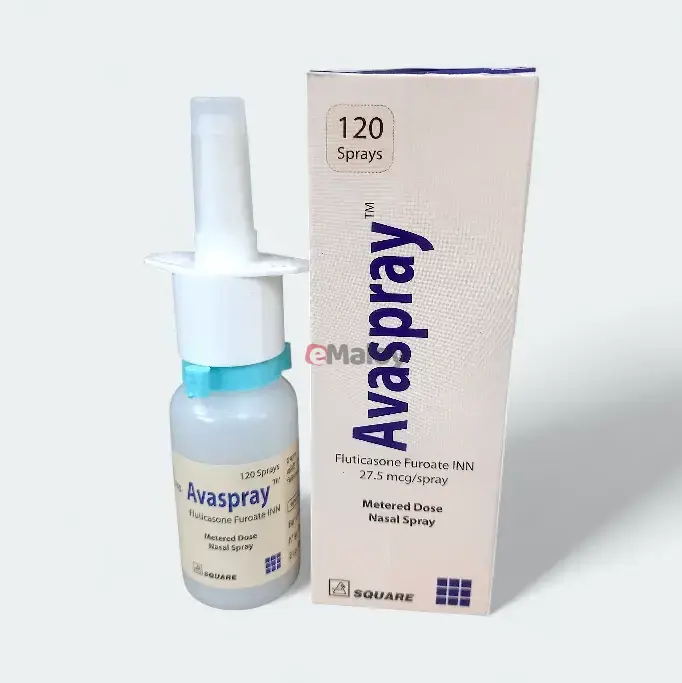
Avaspray contains fluticasone furoate, a synthetic corticosteroid with anti-inflammatory properties. The nasal spray is a topical aqueous suspension administered via a spray pump. Each bottle provides 120 metered sprays and should be discarded after that number to ensure consistent dosing. The pump must be primed before first use or after a period of non-use of one week or more.
Pharmacology
Fluticasone Furoate is a potent synthetic corticosteroid that has a wide range of anti-inflammatory actions. It affects multiple cell types (e.g., mast cells, eosinophils, macrophages) and mediators (e.g., histamine, leukotrienes, cytokines) that are involved in the inflammatory process.
Dosage
- Fluticasone Furoate Nasal Spray:
- Adults and children over 12 years: 2 sprays in each nostril once daily. In some cases, 2 sprays in each nostril twice daily, but not exceeding 4 sprays.
- Children (2-11 years): 1 spray in each nostril once daily.
- Children under 2 years: Not recommended.
- Fluticasone Furoate Inhalation Powder: Administered once daily via oral inhalation, preferably at the same time each day. Do not use more than once every 24 hours.
- Adults and adolescents 12 years and older: The starting dose is usually 100 mcg. A higher dose of 200 mcg may be used if the response to 100 mcg is inadequate after 2 weeks. The maximum recommended daily dose is 200 mcg.
- Children (5 to 11 years): The recommended dose is 50 mcg once daily.
Administration
How to use the Nasal Spray:
- Shake the bottle and remove the dust cover.
- Hold the spray pump with your thumb on the bottom and your forefinger and middle finger on either side of the nozzle.
- Prime the pump by pressing down several times until a fine mist appears. This is required for the first use, if the cap has been off, or if it hasn't been used for 30 days or more.
- Gently blow your nose to clear the nostrils.
- Close one nostril, insert the nozzle into the other, and tilt your head slightly forward.
- Breathe in through your nose while firmly pressing the white collar down once to release a spray.
- Breathe out through your mouth.
- Repeat for consecutive doses and/or for the other nostril.
- Cleaning: Clean the nasal spray at least once a week by removing the applicator and dust cover, washing them in warm water, and letting them air dry before reassembling.
Interaction
The use of potent inhibitors of the cytochrome P450 3A4 (CYP3A4) enzyme, such as ritonavir or ketoconazole, may increase exposure to fluticasone furoate. Coadministration with ritonavir is not recommended, and caution should be used with other potent CYP3A4 inhibitors.
Contraindications
Fluticasone Furoate nasal spray is contraindicated in patients with a known hypersensitivity to any of its ingredients.
Side Effects
- Nasal Spray: Because of minimal systemic absorption, side effects are few. They may include nasal dryness and an increased incidence of nosebleeds.
- Inhalation Powder: The most common side effects in adults and adolescents are nasopharyngitis, bronchitis, upper respiratory tract infection, and headache. In children aged 5 to 11, the most common side effects are pharyngitis, bronchitis, and viral infection.
Pregnancy & Lactation
This is a Pregnancy Category C drug. There are no adequate and well-controlled studies in pregnant women. It should be used during pregnancy only if the potential benefit justifies the potential risk to the fetus. It is not known if fluticasone furoate is excreted in human milk, so caution should be exercised when administering it to nursing women.
Precautions & Warnings
Rarely, immediate hypersensitivity reactions may occur. Intranasal corticosteroids have been associated with rare instances of wheezing, nasal septum perforation, cataracts, glaucoma, and increased intraocular pressure. Although systemic effects are minimal at recommended doses, the risk increases with larger doses, which should be avoided.
Use in Special Populations
- Geriatric: Dosing should be cautious, considering potential decreases in liver, kidney, or heart function.
- Hepatic Impairment: Use with caution in patients with severe hepatic impairment.
- Renal Impairment: No dosage adjustment is required.
Therapeutic Class
Nasal Steroid Preparations
Storage Conditions
Store at a temperature not exceeding 30°C. Do not refrigerate. Protect from light and moisture. Keep out of the reach of children.



Comment