Indications
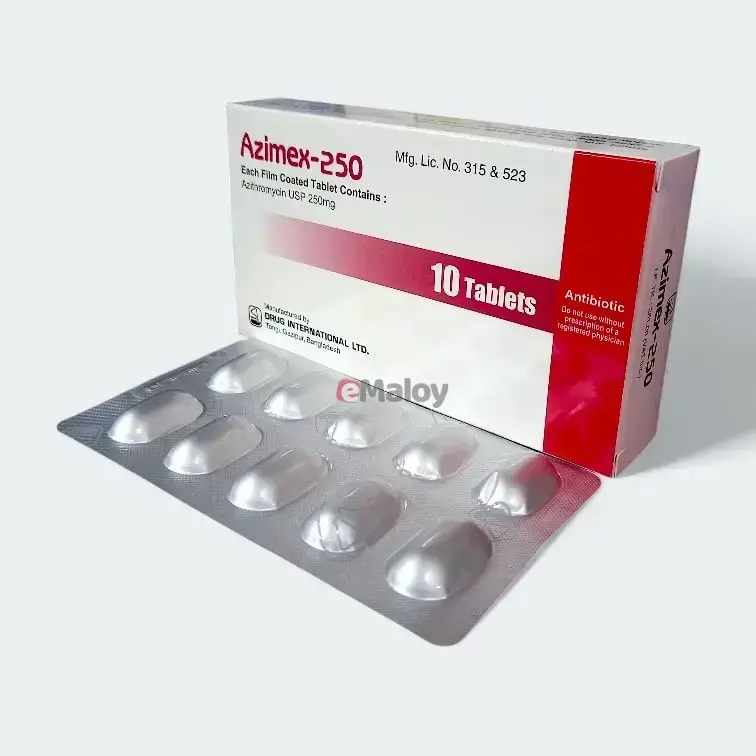
Azimex (Azithromycin) is indicated for treating infections caused by susceptible bacteria in various parts of the body, including:
- Lower respiratory tract: Bronchitis and pneumonia.
- Upper respiratory tract: Sinusitis and pharyngitis/tonsillitis.
- Middle ear: Otitis media.
- Skin and soft tissue.
- Sexually transmitted diseases: Non-gonococcal urethritis and cervicitis caused by Chlamydia trachomatis.
Pharmacology
Azithromycin is a macrolide antibiotic that is acid-stable and readily absorbed orally. It works by binding to the 50S ribosomal subunit of bacteria, which inhibits microbial protein synthesis. It is actively transported to the site of infection by phagocytes, where its concentration can be more than 50 times higher than in the plasma. This extensive tissue uptake and slow release result in a long terminal elimination half-life of 68 hours. The primary route of elimination is biliary excretion.
Dosage & Administration
- Oral (Adults):
- 500 mg once daily for 3 days.
- OR 500 mg on day 1, then 250 mg once daily on days 2-5.
- For sexually transmitted diseases, 1 gm as a single dose.
- Oral (Children):
- 10 mg/kg once daily for 3 days for children over 6 months.
- Doses are also specified by weight categories (e.g., 200 mg for 15-25 kg).
- For typhoid fever, 500 mg once daily for 7-10 days.
- Intravenous (IV) Infusion (Adults):
- Community-acquired pneumonia: 500 mg as a single daily dose for at least two days, followed by oral therapy.
- Pelvic inflammatory disease: 500 mg as a single daily dose for one or two days, followed by oral therapy. The suspension should be reconstituted by adding boiled and cooled water up to the marked line and shaking well. Oral forms should be taken at least 1 hour before or 2 hours after a meal.
Interaction
- Antacids: Azithromycin should be taken at least 1 hour before or 2 hours after antacids.
- Cyclosporin: Caution is advised; cyclosporin levels should be monitored.
- Digoxin: May increase digoxin levels; monitor as needed.
- Ergot derivatives: Contraindicated due to the theoretical risk of ergotism.
- Theophylline/Warfarin: Monitoring is generally recommended.
Contraindications
Azithromycin is contraindicated in patients with:
- Hypersensitivity to Azithromycin or any other macrolide antibiotic.
- Co-administration of ergot derivatives.
- Hepatic diseases.
Side Effects
Azimex is generally well-tolerated. The most common side effects are gastrointestinal, including nausea, vomiting, diarrhea, and abdominal discomfort. Allergic reactions and photosensitivity have occurred. Reversible elevations in liver enzymes and, rarely, cholestatic jaundice have been reported.
Pregnancy & Lactation
- Pregnancy: Azithromycin is a Pregnancy Category B drug. It should be used during pregnancy only if adequate alternatives are not available.
- Lactation: It is not known whether Azithromycin is secreted in breast milk, so caution should be exercised.
Precautions & Warnings
Rare but serious allergic reactions, including angioedema and anaphylaxis, have been reported. Some of these reactions may recur and require prolonged observation and treatment.
Use in Special Populations
- Renal Impairment: No dose adjustment is needed for mild impairment (creatinine clearance > 40 ml/min), but caution is advised in more severe cases.
- Hepatic Impairment: It should not be used in patients with hepatic disease as the liver is the main route of excretion.
- Children/Adolescents: The safety and effectiveness of the IV form in children under 16 have not been established.
Overdose Effects
There is no specific data on Azimex overdose. Typical overdose symptoms with macrolides include hearing loss, severe nausea, vomiting, and diarrhea. Gastric lavage and supportive measures are indicated.
Therapeutic Class
Azimex is a macrolide antibiotic.
Storage Conditions
Keep in a dry place away from light and heat. Keep out of the reach of children.



Comment