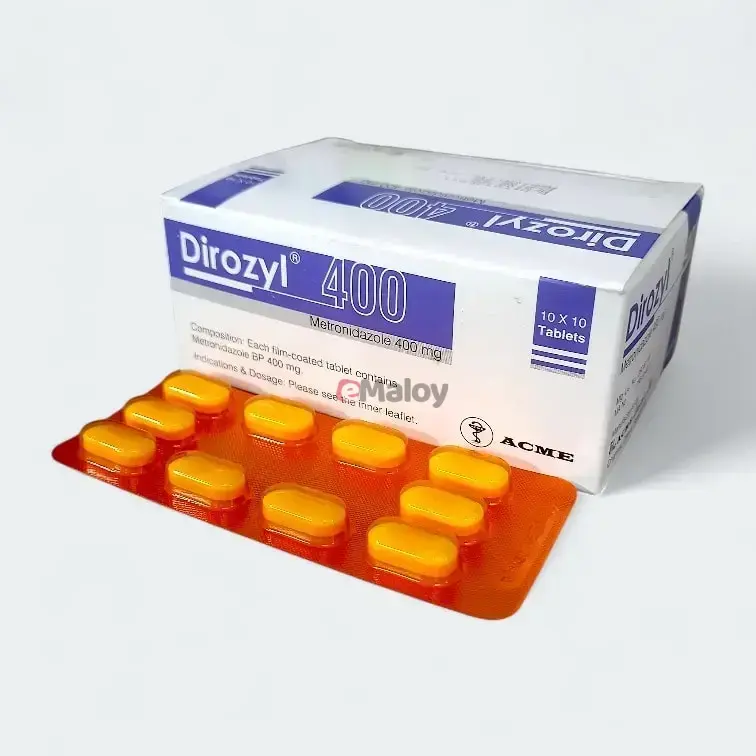
Dirozyl 400: An Antibacterial and Antiprotozoal Medication
Dirozyl 400 contains Metronidazole, an antibacterial and antiprotozoal drug belonging to the imidazole class. It is effective against a wide range of anaerobic bacteria and protozoa, working by interfering with their DNA.
How Dirozyl Works (Pharmacology)
Metronidazole exerts its action by undergoing metabolic reduction of its 5-nitro group within anaerobic bacteria. This reduced form of the drug then interacts with the DNA of the microorganism, leading to a bactericidal action that kills the bacteria.
Key Indications & Benefits
Dirozyl is indicated for the treatment and prevention of various infections caused by anaerobic bacteria and protozoa. Its uses include:
- Prevention of post-operative infections: Particularly those due to anaerobic bacteria (e.g., species of bacteroides and anaerobic streptococci).
- Treatment of established anaerobic infections: Such as septicaemia (blood poisoning), bacteraemia (bacteria in the bloodstream), peritonitis (inflammation of abdominal lining), brain abscess, pelvic abscess, pelvic cellulitis, and post-operative wound infections caused by anaerobes.
- Protozoal infections:
- Trichomoniasis
- Intestinal amoebiasis
- Extra-intestinal & Asymptomatic amoebiasis
- Giardiasis
- Other infections:
- Acute ulcerative gingivitis (gum infection)
- Acute dental infections
- Bacterial vaginosis
- Leg ulcers and pressure sores
Dosage & Administration
Dirozyl is available in various forms including Tablets, Suspension, Vaginal Gel, Suppository, and IV Infusion, with specific dosages for different conditions and age groups.
General Principle: Always consult a registered physician for medication use.
Tablet and Suspension Dosing Examples:
- Trichomoniasis (Adults & Children over 10 yrs):
- 200 mg three times daily or 400 mg twice daily for 7 days.
- Alternatively, 800 mg in the morning and 1-2 gm at night for 2 days.
- Or, a single dose of 2 gm for 1 day.
- Intestinal amoebiasis (Adults & Children over 10 yrs): 800 mg three times daily for 5 days.
- Anaerobic infections (Adults & Children over 10 yrs): 800 mg initially, then 400 mg three times daily for 7 days.
- Surgical prophylaxis (Adults & Children over 10 yrs): 400 mg three times daily, started 24 hours before surgery for 1 day.
(Specific pediatric doses for various conditions are also provided in the source text and should be followed as prescribed by a physician).
Vaginal Gel:
- One applicator full (approx. 5 grams containing approx. 37.5 mg Metronidazole) intravaginally once or twice a day for 5 days. Administer at bedtime for once-a-day dosing.
Suppository (Anaerobic Infections):
- Adults: 1 g every 8 hours for 3 days, then 1 g every 12 hours.
- Children 5-10 years: 500 mg every 8 hours for 3 days, then every 12 hours. Over 10 years, adult dose.
IV Infusion:
- No dilution needed. Do not mix with other drugs.
- Adults and children over 12 years: Infuse 500 mg every 8 hours at 5 ml/minute. Maximum 4 g per 24-hour period. Treatment usually for 7 days.
- Children under 12 years: 7.5 mg/kg body weight/day every 8 hours at 5 ml/minute.
Important Considerations & Warnings
It is crucial to discuss your full medical history with your doctor before taking Dirozyl 400.
Contraindications:
- Patients with a history of hypersensitivity to Metronidazole or other Nitroimidazole derivatives.
Side Effects:
- Common: Metallic taste, nausea, vomiting, diarrhea, drowsiness, rashes.
- Occasionally: Headache.
- Rarely reported (with high dose or prolonged use): Numbness, muscle weakness, painful urination, trouble sleeping, mouth ulcer (indicating potential nerve damage).
- Very rarely: Activation of peptic ulcer, blood dyscrasia (extensive usage), hematemesis or melena (though these are more commonly associated with NSAIDs, they appear in related drug information).
Interactions:
- Disulfiram: Concurrent use may lead to psychotic reactions.
- Alcohol: Avoid alcoholic beverages and alcohol-containing drugs during therapy and for at least one day afterward due to the possibility of a disulfiram-like (antabuse) reaction (flushing, vomiting, tachycardia).
- Oral anticoagulants (warfarin type): Potentiation of anticoagulant effect and increased hemorrhagic risk due to decreased hepatic catabolism. Monitor prothrombin time frequently.
- Lithium: Plasma levels of lithium may be increased.
- Cyclosporin: Close monitoring of serum cyclosporin and creatinine is necessary.
- Phenytoin or phenobarbital: Increased elimination of Dirozyl, leading to reduced plasma levels.
- 5-Fluorouracil: Reduced clearance of 5-fluorouracil, leading to increased toxicity.
- Busulfan: Plasma levels of busulfan may be increased, potentially leading to severe busulfan toxicity.
Pregnancy & Lactation:
- Pregnancy: US FDA Pregnancy Category B. However, adequate and well-controlled studies in pregnant women are lacking. Use during pregnancy only if clearly needed and benefits outweigh risks.
- Lactation: Metronidazole is excreted in human milk. Caution should be exercised, and consideration given to discontinuing nursing if the drug is essential for the mother.
Precautions & Warnings:
- Prolonged treatment: If treatment exceeds the recommended duration due to compelling reasons, regular hematological tests (especially leukocyte count) are recommended. Patients should be monitored for adverse reactions like peripheral or central neuropathy (e.g., paresthesia, ataxia, dizziness, convulsive seizures).
- Hepatic encephalopathy: Administer with caution to patients with hepatic encephalopathy. The daily dosage should be reduced to one third and may be administered once daily.
- Urine darkening: Patients should be warned that Dirozyl may darken urine.
Use in Special Populations:
- Hepatic impairment: Dirozyl is mainly metabolized by the liver. Significant impairment of clearance can occur with advanced hepatic insufficiency, potentially leading to high plasma concentrations and contributing to symptoms of encephalopathy. Dose should be reduced to one-third daily and administered once daily in these patients.
- Renal impairment: The elimination half-life remains unchanged in renal failure, so no routine dosage reduction is needed. However, metabolites are retained, and their clinical significance is unknown. For patients on hemodialysis, re-administer immediately after an 8-hour dialysis period. No routine adjustment needed for intermittent peritoneal dialysis (IDP) or continuous ambulatory peritoneal dialysis (CAPD).
Overdose Effects:
- Reported single oral doses up to 12 g showed symptoms limited to vomiting, ataxia, and slight disorientation.
- There is no specific antidote. Management is symptomatic and supportive, especially for GI effects and potential nerve damage.
Storage Conditions
Store below 30°C. Keep protected from light. Keep medicines out of the reach of children. Do not use later than the date of expiry.




Comment