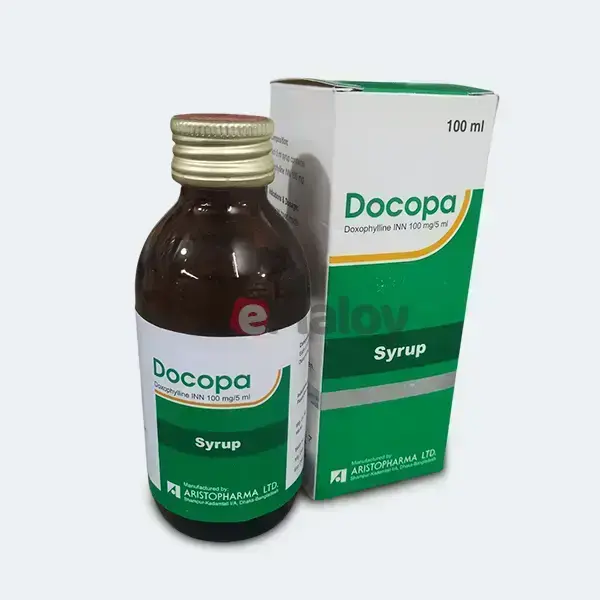
Doxophylline INN 100 mg per 5 ml.
It is manufactured by Aristopharma Ltd. in Bangladesh.
Indications:
Docopa (Doxophylline) is a new generation xanthine derivative, which is a bronchodilator. It is used to treat conditions characterized by bronchospasm (narrowing of the airways), such as:
- Bronchial asthma
- Chronic Obstructive Pulmonary Disease (COPD)
- Other pulmonary diseases with a spastic bronchial component.
Pharmacology:
Doxophylline works by selectively inhibiting phosphodiesterase 4 (PDE4), which leads to relaxation of the bronchial smooth muscles and widening of the airways. Unlike some other xanthine derivatives (like Theophylline), Doxophylline appears to have a lower affinity for adenosine A1 and A2 receptors, which may contribute to its better safety profile. It also inhibits platelet-activating factor (PAF) and the generation of leukotrienes, which are mediators of inflammation.
Dosage and Administration:
The dosage depends on the patient's age and clinical response.
- Adults: 400 mg (20 ml of syrup) daily in the evening. In some cases, 400 mg (20 ml) twice daily may be recommended based on clinical response. Doses as high as 1200 mg/day (60 ml daily, in divided doses) may be prescribed.
- Children (above 6 years of age): The recommended dosage is 6 mg/kg body weight twice daily. The dose may be increased up to 18 mg/kg daily based on clinical response.
- For a 10 kg child: 3 ml (60 mg) twice daily (total 6 ml/day).
- For other weights, calculations based on 6 mg/kg twice daily:
- 15 kg: 4.5 ml twice daily (total 9 ml/day)
- 20 kg: 6 ml twice daily (total 12 ml/day)
- 25 kg: 7.5 ml twice daily (total 15 ml/day)
- 30 kg: 9 ml twice daily (total 18 ml/day)
- 35 kg: 10.5 ml twice daily (total 21 ml/day)
- 40 kg: 12 ml twice daily (total 24 ml/day)
- Children (>12 years of age): 10 ml syrup (200 mg) two or three times daily.
- Elderly patients with concomitant cardiovascular, hepatic, and renal diseases: Recommended dosage should be 200 mg (10 ml syrup) twice daily.
Contraindications:
Docopa is contraindicated in patients with:
- Acute myocardial infarction (recent heart attack).
- Hypotension (low blood pressure).
- Known hypersensitivity to Doxophylline or other xanthine derivatives.
- Nursing mothers (breastfeeding).
Side Effects:
Docopa is generally well tolerated. Side effects, when they occur, are usually mild and similar to those associated with excess caffeine. These may include:
- Nausea
- Vomiting
- Headache
- Upset stomach / Heartburn
- Irritability
- Insomnia (difficulty sleeping)
- Tachycardia (fast heart rate)
- Extrasystoles (skipped heartbeats)
- Tachypnea (rapid breathing)
- In rare cases, hyperglycemia (high blood sugar) or albuminuria (protein in urine).
- Severe cardiac arrhythmias and tonic-clonic seizures may occur in case of overdose.
Precautions and Warnings:
- The half-life of Doxophylline can be prolonged in patients with liver disease, congestive heart failure, and in those taking certain other drugs (e.g., erythromycin, cimetidine, allopurinol, propranolol). In these cases, a lower dose may be needed.
- Phenytoin, other anticonvulsants, and smoking may increase the clearance of Doxophylline, requiring higher doses.
- Use with caution in patients with cardiac disease, hypertension, severe hypoxemia, hyperthyroidism, chronic cor pulmonale, peptic ulcer, and renal impairment.
- In case of side effects, treatment may need to be discontinued or resumed at lower doses after symptoms subside.
Use in Pregnancy and Lactation:
- Pregnancy: Animal studies indicate Doxophylline does not cause fetal harm. However, due to limited human experience during pregnancy, it should only be given to pregnant women if clearly needed.
- Lactation: Docopa is contraindicated in nursing mothers.
Drug Interactions:
- Should not be administered together with other xanthine derivatives (e.g., Theophylline).
- Toxic synergism with Ephedrine has been documented for xanthines.
- Concomitant therapy with Erythromycin, Lincomycin, Allopurinol, Cimetidine, Ranitidine, Propranolol, and anti-flu vaccine may decrease the hepatic clearance of Doxophylline, leading to increased blood levels.
- Phenytoin and other anticonvulsants may increase the clearance of Doxophylline.
Storage Conditions:
Keep in a dry place away from light and heat (below 25°C). Keep out of the reach of children. Doxophylline should only be used on prescription of a specialist physician.
Note: This information is for general knowledge and informational purposes only and does not substitute professional medical advice. Always consult your doctor or pharmacist for specific instructions and guidance regarding your medication.



Comment