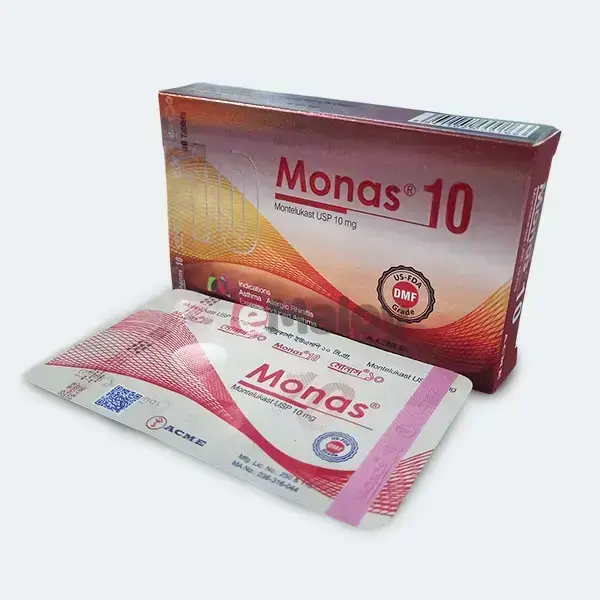
Monas 10 is a film-coated tablet containing Montelukast Sodium USP equivalent to 10 mg of Montelukast. It is manufactured by The ACME Laboratories Ltd. in Bangladesh.
Indications:
Monas 10 (Montelukast) is a selective and orally active leukotriene receptor antagonist. It works by blocking the action of certain natural substances in the body called leukotrienes, which are involved in the inflammatory processes of asthma and allergic rhinitis. Monas 10 is indicated for:
- Prophylaxis and chronic treatment of asthma in adults and adolescents 15 years of age and older.
- Acute prevention of Exercise-Induced Bronchoconstriction (EIB) in adults and adolescents 15 years of age and older.
- Relief of symptoms of Allergic Rhinitis (AR): Both seasonal and perennial allergic rhinitis in adults and adolescents 15 years of age and older.
Pharmacology:
Cysteinyl leukotrienes (LTC4, LTD4, LTE4) are released from various cells, including mast cells and eosinophils, and play a significant role in the pathophysiology of asthma and allergic rhinitis. They contribute to airway edema, smooth muscle contraction, and altered cellular activity associated with inflammation. Montelukast specifically inhibits the cysteinyl leukotriene receptor (CysLT1), thereby reducing these inflammatory responses and alleviating symptoms.
Dosage and Administration:
Monas 10 tablets should be taken orally. They may be taken with or without food. For asthma, it is generally recommended to take it in the evening. Monas 10 is not indicated for use in the reversal of bronchospasm in acute asthma attacks; patients should have appropriate rescue medication available.
- Adults and adolescents 15 years of age and older: 10 mg (one tablet) once daily, in the evening.
- For prevention of Exercise-Induced Bronchoconstriction (EIB), a single dose should be taken at least 2 hours before exercise. Do not take an additional dose within 24 hours if already taking a daily dose for asthma or allergic rhinitis.
Side Effects:
Montelukast is generally well-tolerated. Common side effects include:
- Headache
- Upper respiratory infection
- Diarrhea, nausea, vomiting, abdominal pain
- Fever
- Rash
Less common or rare but serious side effects (which warrant immediate medical attention) can include:
- Neuropsychiatric events: Agitation, aggression, depression, sleep disturbances (e.g., nightmares, insomnia), anxiety, disorientation, hallucinations, irritability, memory impairment, restlessness, somnambulism, suicidal thinking and behavior (including suicide), and tremor.
- Allergic reactions (e.g., angioedema, hives, anaphylaxis).
- Elevated liver enzymes, hepatitis (rare).
- Increased bleeding tendency.
- Churg-Strauss syndrome (a rare form of vasculitis).
Contraindications:
Monas 10 is contraindicated in patients with:
- Known hypersensitivity to Montelukast or any component of the product.
Precautions and Warnings:
- Acute Asthma Attacks: Monas 10 is not a rescue medication for acute asthma attacks. Patients should continue to use their prescribed rescue inhaler for sudden breathing problems.
- Corticosteroid Substitution: Monas 10 should not be abruptly substituted for inhaled or oral corticosteroids. Any reduction in corticosteroid dose should be gradual and under medical supervision.
- Neuropsychiatric Events: Patients, parents, and caregivers should be monitored for neuropsychiatric symptoms. If such symptoms occur, a healthcare provider should be consulted.
- Aspirin Sensitivity: While Monas 10 can improve airway function in aspirin-sensitive asthmatics, it has not been shown to block the bronchoconstrictor response to aspirin or other NSAIDs. Patients with aspirin sensitivity should continue to avoid aspirin and NSAIDs.
- Liver Impairment: No dosage adjustment is required for mild-to-moderate hepatic insufficiency, but caution is advised in severe liver disease.
- Driving/Operating Machinery: May cause dizziness or drowsiness, which could impair the ability to drive or operate machinery.
Pregnancy and Lactation:
- Pregnancy: There are no adequate and well-controlled studies of Montelukast in pregnant women. It should be used during pregnancy only if clearly needed and after a thorough risk-benefit assessment by a doctor.
- Lactation: Montelukast is excreted in breast milk. Caution should be exercised when given to a nursing mother.
Drug Interactions:
Montelukast is metabolized by CYP enzymes (2C8, 2C9, 3A4).
- Phenobarbital, Phenytoin, Rifampicin: These drugs, which induce hepatic metabolism, may decrease the plasma concentration of Montelukast.
- Gemfibrozil (a CYP2C8 and 2C9 inhibitor): Can increase systemic exposure to Montelukast.
- Other medications: Montelukast has been administered with other routine asthma and allergy therapies (e.g., theophylline, prednisone, oral contraceptives, terfenadine, digoxin, warfarin, thyroid hormones, sedative-hypnotics, NSAIDs, benzodiazepines, decongestants) with no apparent increase in adverse reactions.
Storage Conditions:
Store in a cool and dry place below 30°C, protected from light and moisture. Keep out of reach of children.
Note: This information is for general knowledge and informational purposes only and does not substitute professional medical advice. Always consult your doctor or pharmacist for specific instructions and guidance regarding your medication.



Comment