

100% Original Products

Fast Delivery within 24-72 Hours

Cash On Delivery Available

24/7 Order Support via whatsapp
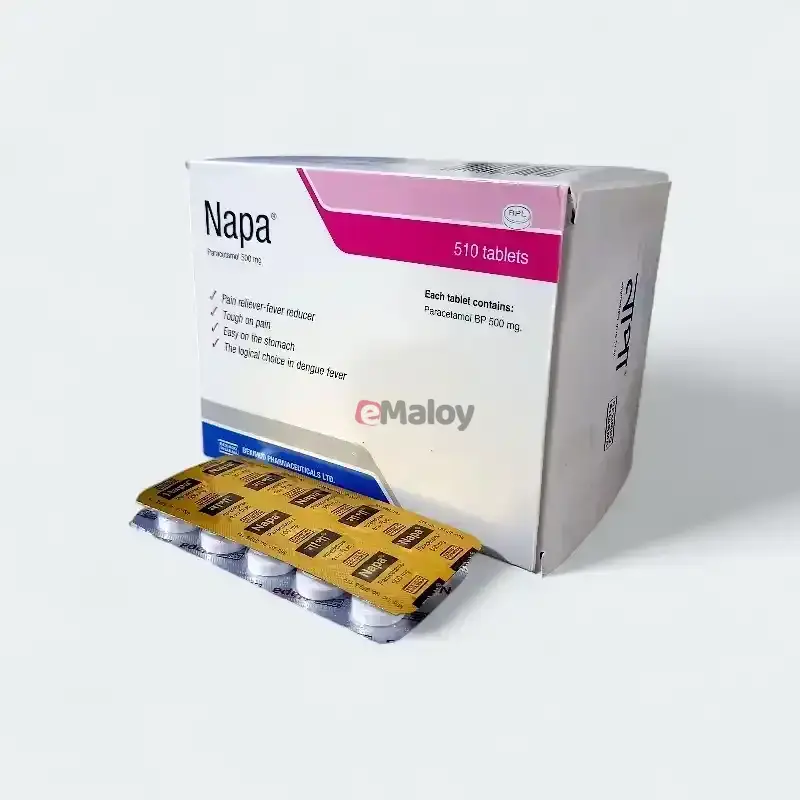
Napa (Paracetamol) provides effective relief for:
✅ Pain Management:
Headaches, migraines, toothaches
Musculoskeletal pain (back pain, sprains, osteoarthritis)
Post-operative/postpartum pain
Dysmenorrhea (period pain)
Pediatric post-vaccination discomfort
✅ Fever Control:
Influenza, common cold, post-surgical pyrexia
Fever of unknown origin
Paracetamol exerts central effects by:
COX Enzyme Inhibition: Blocks COX-2/COX-3 isoforms in CNS → reduces prostaglandin-mediated pain signaling
Hypothalamic Modulation: Resets body's thermostat → promotes heat dissipation (antipyresis)
No Peripheral Anti-Inflammatory Action: Unlike NSAIDs, minimally affects peripheral COX-1
| Formulation | Age Group | Dosage | Max Daily |
|---|---|---|---|
| Standard Tablets | Adults | 500-1000 mg every 4-6h | 4000 mg (8 tabs) |
| Extended-Release | >12 years | 1000 mg every 6-8h (swallow whole) | 3000 mg (6 tabs) |
| Syrup (120mg/5mL) | 1-5 years | 5-10 mL every 4-6h | 5 doses/day |
| IV Infusion | <50 kg patients | 12.5 mg/kg every 4h | 75 mg/kg |
| Suppositories | 6-12 years | 250-500 mg every 4-6h | 2000 mg |
Critical Notes:
Hepatic Risk: Never exceed 4000 mg/day (adults) or 75 mg/kg/day (children)
Minimum Interval: 4 hours between doses
❌ Absolute Contraindications:
Hypersensitivity to paracetamol
Severe hepatic impairment (Child-Pugh C)
⚠️ High-Risk Populations:
Chronic alcoholics: Max 2000 mg/day
Malnourished patients: Reduced glutathione reserves
Renal impairment (CrCl <30 mL/min): Extend dosing interval to 8h
Concurrent enzyme inducers: (e.g., rifampicin, carbamazepine)
Common (Dose-related):
Asymptomatic transaminase elevation (mild)
Rare but Severe:
Hepatotoxicity (overdose)
Thrombocytopenia, agranulocytosis
Stevens-Johnson syndrome (skin reactions)
Acute renal failure (tubular necrosis)
| Concomitant Agent | Risk | Management |
|---|---|---|
| Alcohol | ↑ Hepatotoxicity 10x | Avoid completely |
| Warfarin | ↑ INR (prolonged bleeding) | Monitor INR weekly |
| Enzyme Inducers | ↑ Toxic metabolite formation | Max 2000 mg/day |
| Cholestyramine | ↓ Absorption (40%) | Separate doses by 2h |
Stage 1 (0-24h): Nausea, vomiting, pallor
Stage 2 (24-72h): RUQ pain, elevated LFTs
Stage 3 (72-96h): Hepatic failure, encephalopathy
Emergency Treatment:
<1h post-ingestion: Activated charcoal (1g/kg)
Acetylcysteine Regimen:
IV: 150 mg/kg over 15min → 50 mg/kg over 4h → 100 mg/kg over 16h
Oral: 140 mg/kg load → 70 mg/kg every 4h (17 doses)
Monitor LFTs, INR, creatinine q6h
Pregnancy (Category A): Safest analgesic for all trimesters
Breastfeeding: Compatible (milk conc. <0.2% maternal dose)
Geriatric: Reduce dose by 25% if frail/malnourished
Pediatrics: Use weight-based dosing (not age-based)
✔️ Must Avoid:
Alcohol during treatment
Combining with other paracetamol products
Crushing extended-release tablets
⚠️ Seek Immediate Help If:
No pain relief after 3 doses
Yellow eyes/skin or dark urine
Rash/mucosal lesions
Store below 25°C in original packaging
Protect from moisture
Child-resistant packaging essential (leading cause of pediatric poisoning)
Registered চিকিৎসকের পরামর্শ মোতাবেক ঔষধ সেবন করুন
Not for inflammation control - consult for NSAID alternatives
Your email address will not be published. Required fields are marked *
Please login to write review!
Looks like there are no reviews yet.
Comment