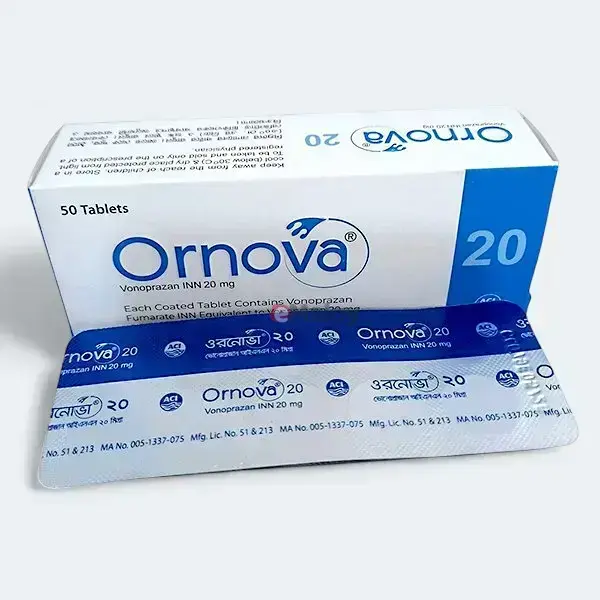
Ornova (Vonoprazan): A Potassium Competitive Acid Blocker (P-CAB)
Ornova contains Vonoprazan, a potassium competitive acid blocker (P-CAB). It is indicated for the treatment and prevention of various acid-related gastrointestinal conditions, and as an adjunct in Helicobacter pylori eradication regimens. It is classified as a Potassium competitive acid blocker.
How Ornova Works (Pharmacology)
Vonoprazan is a novel type of acid-suppressing drug that works differently from proton pump inhibitors (PPIs).
- Potassium Competitive Acid Blocker (P-CAB): Unlike PPIs, Vonoprazan directly and reversibly inhibits the H+, K+-ATPase (proton pump) in gastric parietal cells by competing with potassium ions.
- No Acid Activation Required: It does not require activation by acid, allowing it to exert its inhibitory effect immediately upon administration.
- Strong Basicity and Prolonged Residence: Vonoprazan has a strong basicity, causing it to accumulate and reside on the acid production site of gastric parietal cells for a prolonged period. This leads to sustained inhibition of gastric acid production.
- Mucosal Protection: It exerts a strong inhibitory effect on the formation of mucosal damage in the upper gastrointestinal tract.
Key Indications & Benefits
Ornova is indicated for:
- Gastric ulcer
- Duodenal ulcer
- Reflux esophagitis
- Prevention of recurrence of gastric or duodenal ulcer during low-dose aspirin administration.
- Prevention of recurrence of gastric or duodenal ulcer during NSAID (non-steroidal anti-inflammatory drug) administration.
- Adjunct to Helicobacter pylori eradication in the following conditions:
- Gastric ulcer
- Duodenal ulcer
- Gastric mucosa-associated lymphatic tissue (MALT) lymphoma
- Idiopathic thrombocytopenic purpura
- The stomach after endoscopic resection of early-stage gastric cancer
- Helicobacter pylori gastritis
Dosage & Administration
Vonoprazan can be taken without regard to food or timing of food. Always consult a registered physician for medication use.
- Gastric ulcer: Usual adult dose is 20 mg once daily for an 8-week treatment.
- Duodenal ulcer: Usual adult dose is 20 mg once daily for a 6-week treatment.
- Reflux esophagitis:
- Initial: 20 mg once daily for 4 weeks. If insufficient, extend up to 8 weeks.
- Maintenance therapy (for recurrence/recrudescence): 10 mg once daily. If efficacy is inadequate, may increase to 20 mg once daily.
- Prevention of recurrence of gastric or duodenal ulcer during low-dose aspirin administration: 10 mg once daily.
- Prevention of recurrence of gastric or duodenal ulcer during NSAID administration: 10 mg once daily.
- Adjunct to Helicobacter pylori eradication (Adults):
- First-line regimen: 20 mg Vonoprazan, 750 mg amoxicillin hydrate, and 200 mg clarithromycin, all administered orally twice daily for seven days. (Clarithromycin dose may increase up to 400 mg twice daily as clinically warranted).
- Alternative regimen (if first-line unsuccessful): 20 mg Vonoprazan, 750 mg amoxicillin hydrate, and 250 mg metronidazole, all administered orally twice daily for seven days.
Important Considerations & Warnings
It is crucial to discuss your full medical history with your doctor before taking Ornova.
Contraindications:
- Patients with hypersensitivity to Vonoprazan or any excipient of the product.
- Patients receiving atazanavir sulfate, nelfinavir, or rilpivirine hydrochloride.
Side Effects:
- Common: Diarrhea, constipation, nausea, abdominal distension.
- Hypersensitivity reactions: Drug hypersensitivity (including anaphylactic shock), drug eruption, urticaria, rash.
- Hepatic effects: Hepatotoxicity, jaundice, increased gamma-glutamyl transferase, increased AST, abnormal liver function test, increased ALT, increased ALP, increased LDH, increased y-GPT.
- Other: Edema, eosinophilia.
Pregnancy & Lactation:
- Pregnancy: Should be used in pregnant women or women with possibility of pregnancy only if the expected therapeutic benefit outweighs any possible risk.
- Lactation: It is advisable to avoid administration to nursing mothers. If administration is indispensable, nursing should be discontinued.
Precautions & Warnings:
- Close Observation: During treatment, closely observe the course of the disease and use the minimum therapeutically necessary dose.
- Long-term Treatment: For long-term treatment with Ornova, close observation (e.g., by endoscopy) should be made.
- Maintenance of Reflux Esophagitis: Administer only to patients who experience repeated recurrence and recrudescence of the condition. Avoid administration to patients who do not necessitate maintenance healing.
- Dose Reduction/Suspension: When healing is maintained for a long period and there is no risk of recurrence, consider dose reduction (from 20 mg to 10 mg) or suspension of administration.
Use in Special Populations:
- Elderly: Administer carefully, as physiological functions (hepatic/renal) are generally decreased.
- Children less than 18 years of age: Safety and efficacy have not been established. Administration is not recommended.
- Renal impairment:
- Mild to moderate (eGFR 30 to 89 mL/min): No dose adjustment recommended.
- Severe (eGFR < 30 mL/min):Avoid use.
- Hepatic impairment:
- Mild (Child-Pugh A): No dose adjustment recommended.
- Moderate to severe (Child-Pugh B or C):Avoid use.
Overdose Effects
- There is no experience of overdose with Ornova.
- Ornova is not removed from circulation by hemodialysis.
- If overdose occurs, treatment should be symptomatic and supportive.
Storage Conditions
Store below 30°C, in a cool and dry place. Keep away from light. Keep all medicines out of the reach of children.



Comment