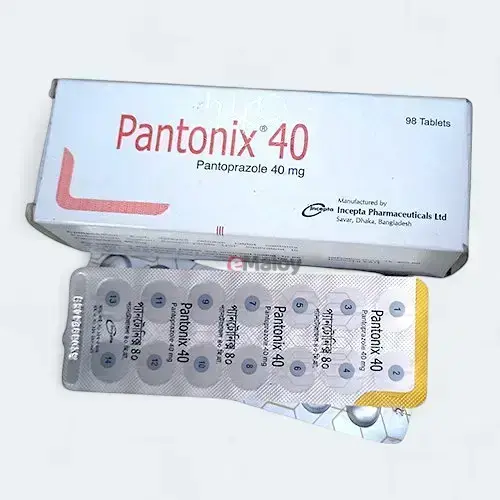
Pantonix (Pantoprazole): A Proton Pump Inhibitor (PPI)
Pantonix contains Pantoprazole, a proton pump inhibitor (PPI) that effectively suppresses gastric acid secretion. It is indicated for conditions where reducing stomach acid has a therapeutic benefit, such as peptic ulcer diseases, GERD, and for Helicobacter pylori eradication. It belongs to the therapeutic class of Proton Pump Inhibitor.
How Pantonix Works (Pharmacology)
Pantoprazole works by targeting the final step of acid production in the stomach:
- Proton Pump Inhibition: It covalently binds to the H+/K+ATPase enzyme system (the "proton pump") located at the surface of the gastric parietal cells. This binding permanently inactivates the pump for its lifespan.
- Reduced Acid Secretion: This action leads to a potent inhibition of both basal (resting) and stimulated gastric acid secretion, regardless of the stimulus. This acid-suppressing effect persists for longer than 24 hours.
Key Indications & Benefits
Pantonix is indicated for conditions where suppression of acid secretion provides therapeutic benefit:
- Peptic ulcer diseases: Including benign gastric ulcer and duodenal ulcer.
- Gastroesophageal reflux disease (GERD): Including erosive esophagitis.
- Ulcers induced by non-steroidal anti-inflammatory drugs (NSAIDs): For prophylaxis of NSAID-associated gastric or duodenal ulcer.
- Eradication of Helicobacter pylori: Used in combination with antibiotics.
- Zollinger-Ellison Syndrome: A condition characterized by excessive acid production.
- Prevention of rebleeding in peptic ulcer (IV administration).
- Prophylaxis of acid aspiration (IV administration).
- Long-term management of Zollinger-Ellison Syndrome and other pathological hypersecretory conditions (IV administration).
Dosage & Administration
Pantonix is available in oral (tablet) and intravenous (IV injection/infusion) forms. Oral tablets should not be split, chewed, or crushed. Always consult a registered physician for medication use.
Oral Dosing:
- Benign gastric ulcer: 40 mg once daily in the morning for 4 weeks; may continue for another 4 weeks if not fully healed.
- Gastro-esophageal reflux disease (GERD): 20-40 mg once daily in the morning for 4 weeks; may continue for another 4 weeks if not fully healed. Maintenance dose is 20 mg daily, which may be increased to 40 mg daily.
- Duodenal ulcer: 40 mg once daily in the morning for 2 weeks; may continue for another 2 weeks if not fully healed.
- Duodenal ulcer associated with Helicobacter pylori (in combination with antibiotics):
- Pantoprazole 40 mg twice daily, plus:
- Amoxicillin 1 g and Clarithromycin 500 mg (both twice daily for one week), OR
- Clarithromycin 250 mg and Metronidazole 400 mg (both twice daily for one week).
- Prophylaxis of NSAID-associated gastric or duodenal ulcer: 20 mg daily for those requiring long-term NSAID treatment.
- Zollinger-Ellison Syndrome (Oral): Initially 80 mg once daily, adjusted according to response (elderly max. 40 mg daily). Daily doses above 80 mg should be given in 2 divided doses.
IV Injection/Infusion Dosing:
- Duodenal ulcer and gastric ulcer: 40 mg once daily for 7-10 days.
- Gastroesophageal reflux disease with a history of erosive esophagitis: 40 mg once daily for 7-10 days.
- Prevention of rebleeding in peptic ulcer: 80 mg IV bolus, followed by 8 mg/hour infusion for 72 hours.
- Prophylaxis of acid aspiration: 80 mg IV every 12 hours for 24 hours, followed by 40 mg every 12 hours.
- Long-term management of Zollinger-Ellison Syndrome and other pathological hypersecretory conditions: 80 mg IV every 12 hours; may increase to 80 mg every 8 hours if needed, may titrate to higher doses depending on acid output.
Reconstitution & Administration for IV:
- IV Injection: Add 10 ml of 0.9% Sodium Chloride Injection to the vial. Administer slowly over at least 2 to 5 minutes. Use freshly prepared solution; reconstituted solution can be stored at room temperature (up to 30°C) for maximum 4 hours.
- IV Infusion: Reconstitute with 10 ml of 0.9% Sodium Chloride Injection, then further dilute to a final volume of 100 ml with 0.9% Sodium Chloride Injection, 5% Dextrose, or Lactated Ringer's Injection. Infuse over approximately 15 minutes. Reconstituted solution can be stored for 4 hours prior to further dilution. Admixture can be stored at room temperature (up to 30°C) and used within 24 hours from initial reconstitution.
Important Considerations & Warnings
It is crucial to discuss your full medical history with your doctor before taking Pantonix.
Contraindications:
- Patients with known hypersensitivity to any component of the formulation.
Side Effects:
- Generally well tolerated in short-term and long-term treatment.
- Common: Headache and diarrhea.
- Rare: Abdominal pain, flatulence, rash, insomnia, and hyperglycemia.
Pregnancy & Lactation:
- US FDA Pregnancy Category B.
- No adequate and well-controlled studies in pregnant women. Use during pregnancy only if clearly needed, as animal reproduction studies are not always predictive of human response.
- Lactation: Pantoprazole has been shown to be excreted in human milk. A decision should be made whether to discontinue nursing or discontinue the drug, considering the benefit of the drug to the mother.
Precautions & Warnings:
- Tablet Administration: Patients should be cautioned that Pantonix tablets should not be split, chewed, or crushed.
- Long-term Therapy: May lead to malabsorption of cyanocobalamin (Vitamin B12) or may increase the risk of osteoporosis-related disorders.
Drug Interactions:
- No significant drug interactions have been observed in clinical studies. (However, PPIs can affect absorption of drugs dependent on gastric pH, and could interact with drugs metabolized by CYP enzymes, though this text states "No significant drug interactions.")
Overdose Effects
- There are no known symptoms of overdosage in humans.
- Pantonix is highly protein bound and therefore not readily dialyzable.
- Apart from symptomatic and supportive management, no specific therapy is recommended.
Storage Conditions
Keep in a dry place, away from light and heat. Keep out of the reach of children.



Comment