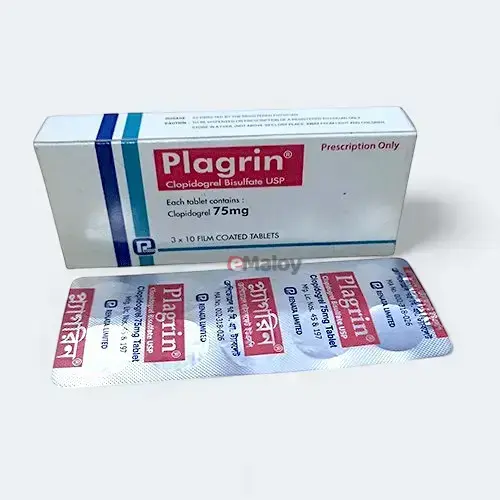
Plagrin (Clopidogrel): An Antiplatelet Drug
Plagrin contains Clopidogrel, a prodrug that inhibits platelet activation and aggregation. It is indicated to reduce the rate of myocardial infarction (MI) and stroke in patients with various cardiovascular conditions. It belongs to the therapeutic class of Anti-platelet drugs.
How Plagrin Works (Pharmacology)
Clopidogrel is a prodrug, meaning it needs to be metabolized in the body to become active. Its mechanism of action involves:
- Irreversible P2Y12 ADP Receptor Binding: The active metabolite of Clopidogrel irreversibly binds to the P2Y12 class of ADP receptors on the surface of platelets.
- Inhibition of Platelet Activation and Aggregation: This binding prevents ADP from activating its receptor, thereby inhibiting platelet activation and subsequent aggregation. Since the binding is irreversible, the platelets are affected for their entire lifespan (7-10 days).
- Dose-Dependent Inhibition: Dose-dependent inhibition of platelet aggregation can be observed within 2 hours of a single oral dose. With repeated doses of 75 mg once daily, inhibition reaches a steady state between Day 3 and Day 7.
Key Indications & Benefits
Plagrin is indicated to reduce the rate of myocardial infarction (MI) and stroke in the following patient populations:
- Acute Coronary Syndrome (ACS):
- Non-ST-segment elevation ACS (unstable angina [UA]/non-ST-elevation myocardial infarction [NSTEMI]).
- Acute ST-elevation myocardial infarction (STEMI).
- Recent MI, Recent Stroke, or Established Peripheral Arterial Disease: In patients with a history of recent MI, recent stroke, or established peripheral arterial disease.
Dosage & Administration
Plagrin is given orally with or without food. Always consult a registered physician for medication use.
- Acute Coronary Syndrome:
- Loading Dose: For patients needing an antiplatelet effect within hours, initiate with a single 300 mg (4 tablets) oral loading dose.
- Maintenance Dose: Continue with 75 mg once daily thereafter.
- Note: Initiating without a loading dose will delay the establishment of an antiplatelet effect by several days.
- Recent MI, Recent Stroke, or Established Peripheral Arterial Disease:
- 75 mg once daily orally, without a loading dose.
Important Considerations & Warnings
It is crucial to discuss your full medical history with your doctor before taking Plagrin.
Contraindications:
- Hypersensitivity to Clopidogrel or any component of the product.
- Active pathological bleeding, such as peptic ulcer or intracranial hemorrhage.
Side Effects:
- Common: Bleeding, diarrhea, gastrointestinal discomfort, hemorrhage, skin reactions.
- Rare: Acquired hemophilia, anemia, angioedema, arthralgia (joint pain), arthritis, bone marrow disorders.
Pregnancy & Lactation:
- Pregnancy: There are no adequate and well-controlled studies in pregnant women. It should be used during pregnancy only if clearly needed.
- Lactation: It is unknown whether Clopidogrel is excreted in human breast milk. A decision should be made whether to discontinue nursing or to discontinue the drug, considering the importance of the drug to the mother.
Precautions & Warnings:
- Prodrug Metabolism and Genetic Variations: Clopidogrel is a prodrug, and its metabolism to the active metabolite can be impaired by genetic variations in CYP2C19 (poor metabolizers) and by drugs that inhibit CYP2C19 (e.g., Omeprazole, Esomeprazole). Concomitant use with these drugs or in CYP2C19 poor metabolizers may reduce the antiplatelet activity of Plagrin, potentially diminishing its therapeutic effect.
- Increased Bleeding Risk: As Plagrin inhibits platelet aggregation for the lifetime of the platelet (7-10 days), the risk of bleeding may increase.
- Platelet Transfusions: Platelet transfusions within 4 hours of a loading dose or 2 hours of a maintenance dose may be less effective in restoring hemostasis.
- Discontinuation of Plagrin: Discontinuation increases the risk of cardiovascular events.
- Elective Surgery: Discontinue 5 days prior to elective surgery that has a major risk of bleeding. Resume Plagrin as soon as hemostasis is achieved.
- Thrombotic Thrombocytopenic Purpura (TTP): TTP has been reported and requires urgent treatment, including plasmapheresis (plasma exchange).
- Hypersensitivity: Hypersensitivity reactions, including rash, angioedema, or hematologic reactions, have been reported in patients receiving Clopidogrel or with a history of hypersensitivity to other thienopyridines.
Use in Special Populations:
- Pediatric populations: Safety and effectiveness have not been established.
- Elderly patients: No dosage adjustment is necessary.
Drug Interactions:
- NSAIDs, Warfarin, SSRIs, SNRIs: Concomitant use increases the risk of bleeding.
- CYP2C19 inhibitors (Omeprazole or Esomeprazole): Avoid concomitant use as they may reduce the antiplatelet activity of Clopidogrel.
- Repaglinide (CYP2C8 substrates): Avoid concomitant use as it increases plasma concentrations of Repaglinide.
Overdose Effects
- Overdose following Clopidogrel administration may lead to bleeding complications.
- Management: Based on biological plausibility, platelet transfusion may help restore clotting ability.
Storage Conditions
Keep below 30°C temperature in a dry place. Protected from light. Do not freeze. Keep out of the reach of children.



Comment