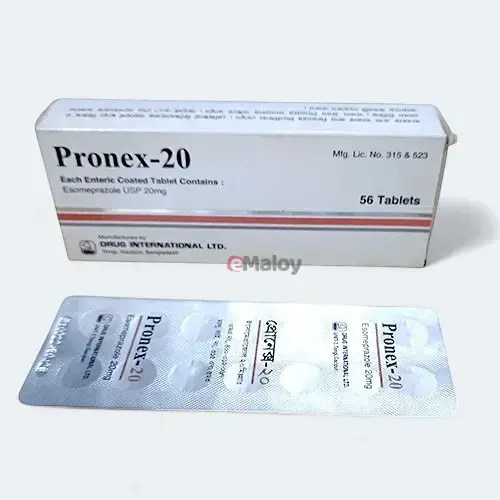
Pronex (Esomeprazole): A Proton Pump Inhibitor (PPI)
Pronex contains Esomeprazole, which is the S-isomer of omeprazole and a proton pump inhibitor (PPI). It effectively suppresses gastric acid secretion and is used to treat various acid-related conditions.
How Pronex Works (Pharmacology)
Esomeprazole works by:
- Specific Inhibition of H+/K+-ATPase: It specifically inhibits the H+/K+-ATPase (the proton pump) in the gastric parietal cells. This enzyme is responsible for pumping hydrogen ions (protons) into the stomach lumen, which is the final step in acid production.
- Reduced Gastric Acid Secretion: By inhibiting the proton pump, Esomeprazole effectively reduces gastric acid secretion.
- Optical Isomer Advantage: Being the first single optical isomer of a PPI, Esomeprazole is designed to provide better acid control compared to racemic proton pump inhibitors.
Pharmacokinetics:
- Absorption: Esomeprazole capsules contain an enteric-coated pellet formulation, ensuring absorption from the gastrointestinal tract. Peak plasma levels are reached around 1.5 hours after oral administration.
- Metabolism: Extensively metabolized in the liver, primarily by the CYP2C19 enzyme, and to a lesser extent by CYP3A4.
- Excretion: Less than 1% of Esomeprazole is excreted unchanged in the urine.
Key Indications & Benefits
Pronex is indicated for:
- Relief of chronic heartburn symptoms and other symptoms associated with GERD (Gastroesophageal Reflux Disease).
- Healing of erosive esophagitis.
- Maintenance of healing of erosive esophagitis.
- In combination with amoxicillin and clarithromycin for the eradication of Helicobacter pylori infection in patients with duodenal ulcer disease.
- Zollinger-Ellison Syndrome.
- Acid-related Dyspepsia.
- Duodenal & Gastric ulcer.
- Risk reduction of rebleeding of Gastric or Duodenal Ulcers following therapeutic endoscopy (IV formulation in adults).
Dosage & Administration
Pronex can be administered orally (tablet, capsule, or oral suspension) or via IV injection/infusion. Always consult a registered physician for medication use.
Oral Dosage Forms (Tablet/Capsule/Suspension):
- Healing of Erosive Esophagitis: 20 mg or 40 mg once daily for 4-8 weeks. An additional 4-8 weeks may be considered if needed.
- Maintenance of Healing of Erosive Esophagitis: 20 mg once daily (clinical studies did not extend beyond 6 months).
- Symptomatic GERD: 20 mg once daily for 4 weeks. An additional 4 weeks may be considered if symptoms persist.
- Helicobacter Pylori Eradication (Triple Therapy): Esomeprazole 40 mg once daily for 10 days, Amoxicillin 1000 mg twice daily for 10 days, Clarithromycin 500 mg twice daily for 10 days.
- Zollinger-Ellison Syndrome: 20-80 mg once daily. Dose adjusted individually.
- Acid-related Dyspepsia: 20-40 mg once daily for 2-4 weeks.
- Duodenal Ulcer: 20 mg once daily for 2-4 weeks.
- Gastric Ulcer: 20-40 mg once daily for 4-8 weeks.
IV Injection or IV Infusion:
- GERD with Erosive Esophagitis:
- Adults (≥18 years): 20 mg or 40 mg once daily. IV Injection: >3 minutes. IV Infusion: 10-30 minutes.
- Pediatric Patients (1 year to 17 years): Body weight <55 kg: 10 mg once daily. Body Weight ≥55 kg: 20 mg once daily. IV Infusion: 10-30 minutes.
- 1 month to <1 year: 0.5 mg/kg once daily. IV Infusion: 10-30 minutes.
- Risk reduction of rebleeding of Gastric or Duodenal Ulcers (Adults ≥18 years): 80 mg IV Infusion over 30 minutes, followed by a continuous infusion of 8 mg/h for a total treatment duration of 72 hours.
Administration:
- Tablets/Capsules: Should be swallowed whole, one hour before a meal. If swallowing difficulty, capsules can be opened and pellets mixed with a tablespoon of applesauce (not hot, soft, not chewed/crushed, and consumed immediately).
- Oral Suspension: Whole packet contents into 15 ml water, stir, leave 2-3 minutes to thicken, stir again, and drink within 30 minutes. Can be administered via nasogastric/gastric tube with 15ml water.
- IV Injection: Reconstitute dry powder with 5 ml of 0.9% Sodium Chloride. Administer intravenously over at least 3 minutes. Use prepared solution within 12 hours.
Important Considerations & Warnings
It is crucial to discuss your full medical history with your doctor before taking Pronex.
Contraindications:
- Patients with known hypersensitivity to Esomeprazole or any of the formulation components.
Side Effects:
- Most frequently occurring: Headache, diarrhea, nausea, flatulence, abdominal pain, constipation, and dry mouth.
- No significant differences in adverse events between short-term and up to 12-month maintenance treatment.
Pregnancy & Lactation:
- Pregnancy: There are no adequate and well-controlled studies in pregnant women. Animal studies have not shown teratogenic effects. Use during pregnancy should only be considered if clearly needed.
- Lactation: The excretion of Esomeprazole in milk has not been studied. Breast-feeding should therefore be discontinued if the use of Esomeprazole is considered essential.
Precautions & Warnings:
- Gastric Malignancy: Symptomatic response to therapy with Pronex does not rule out the presence of gastric malignancy.
- Administration: Ensure correct administration as detailed above (e.g., swallowing whole, not chewing pellets).
- Antacids: Antacids may be used concurrently with Pronex.
Drug Interactions:
- CYP2C19 Inhibition: Pronex may potentially interfere with CYP2C19, its major metabolizing enzyme.
- Diazepam: Co-administration with diazepam (a CYP2C19 substrate) resulted in a 45% decrease in diazepam clearance and increased plasma levels.
- Gastric pH-dependent Absorption: As Pronex inhibits gastric acid secretion, it may interfere with the absorption of drugs whose bioavailability is dependent on gastric pH (e.g., ketoconazole, iron salts, and digoxin).
- No clinically significant interactions (expected/observed): With phenytoin, warfarin, quinidine, clarithromycin, amoxicillin, oral contraceptives.
- Combination Therapy with Clarithromycin: Co-administration of Esomeprazole, clarithromycin, and amoxicillin results in increased plasma levels of Esomeprazole and 14-hydroxyclarithromycin.
Use in Special Populations
- Pediatric Use: Safety and effectiveness in pediatric patients have not been established for oral dosage forms. IV dosing guidance is provided for pediatric patients from 1 month to 17 years.
- Geriatric Use: No overall differences in safety and efficacy have been observed, but greater sensitivity in some older individuals cannot be ruled out. No specific dosage adjustment is usually necessary.
- Hepatic Insufficiency: No dosage adjustment recommended for mild to moderate hepatic insufficiency. However, in severe hepatic insufficiency, a dose of 20 mg once daily should not be exceeded.
- Renal Insufficiency: Pharmacokinetics are not expected to be altered, and no dosage adjustment is needed, as less than 1% is excreted unchanged in urine.
Overdose Effects
- Symptoms of acute toxicity (in rats at high doses): Reduced motor activity, changes in respiratory frequency, tremor, ataxia, and intermittent clonic convulsions.
- No reports of overdose with Pronex in humans.
- No specific antidote is known.
- Management: Treatment should be symptomatic and supportive. Since Esomeprazole is extensively protein-bound, it is not expected to be removed by dialysis.
Storage Conditions
Store at a temperature not exceeding 30°C in a dry place. Protect from light and moisture. Keep out of reach of children.



Comment