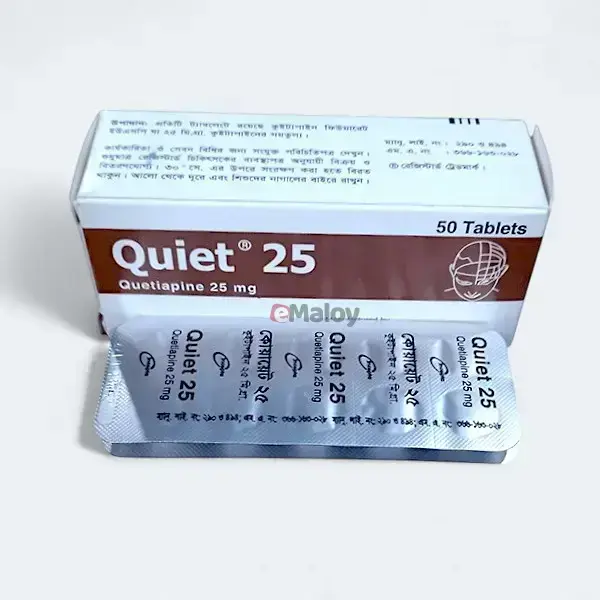
Quiet (Quetiapine Fumarate): An Atypical Psychotropic Agent
Quiet contains Quetiapine Fumarate, an atypical psychotropic agent belonging to the dibenzothiazepine derivatives. It is indicated for the treatment of various acute and chronic psychoses, including schizophrenia and bipolar disorder (manic, depressive, and maintenance phases). It belongs to the therapeutic class of atypical neuroleptic drugs.
How Quiet Works (Pharmacology)
The exact mechanism of action of Quetiapine is not fully known, but it is believed to be mediated through a combination of its antagonist effects on multiple neurotransmitter receptors in the brain:
- Dopamine D1 and D2 Receptors: Antagonism at these receptors is proposed to be key to its efficacy in schizophrenia.
- Serotonin 5HT1A and 5HT2 Receptors: Antagonism at these receptors also contributes to its therapeutic effects.
- Histamine H1 Receptors: Antagonism at H1 receptors may explain side effects like somnolence (drowsiness).
- Adrenergic α1 and α2 Receptors: Antagonism at α1 receptors may explain orthostatic hypotension (a drop in blood pressure upon standing) observed with this drug.
- No Appreciable Affinity: Quetiapine has no significant affinity for cholinergic muscarinic and benzodiazepine receptors.
Key Indications & Benefits
Quiet is indicated for the treatment of:
- Acute and chronic psychoses, including schizophrenia.
- Bipolar Disorder, including:
- Treatment of manic episodes satisfying DSM-IV criteria for mania associated with bipolar disorder.
- Treatment of depressive episodes associated with bipolar disorder.
- Maintenance treatment of bipolar I disorder, in combination with a mood stabilizer, for the prevention of recurrence of manic, depressive, or mixed episodes.
Dosage & Administration
Quiet should be administered twice daily, with or without food, except for depressive episodes where it's once daily at bedtime. Dosage should always be as directed by a registered physician.
Acute and Chronic Psychoses, including Schizophrenia:
- Initial Dosing (Total Daily Dose):
- Day 1: 50 mg
- Day 2: 100 mg
- Day 3: 200 mg
- Day 4: 300 mg
- From Day 4 onwards: Titrate to usual effective dose range of 300-450 mg/day.
- Adjustments: Depending on clinical response and tolerability, dose can be adjusted within the range of 150 to 750 mg/day.
Manic Episodes Associated with Bipolar Disorder:
- Initial Dosing (Total Daily Dose):
- Day 1: 100 mg
- Day 2: 200 mg
- Day 3: 300 mg
- Day 4: 400 mg
- Further Adjustments: Up to 800 mg/day by Day 6, in increments of no greater than 200 mg/day.
- Adjustments: Dose may be adjusted within the range of 200 to 800 mg/day.
- Usual effective dose: 400 to 800 mg/day.
Depressive Episodes Associated with Bipolar Disorder:
- Administered once daily at bedtime.
- Usual dose: 300 mg/day.
- Initial Dosing (Daily Dose):
- Day 1: 50 mg
- Day 2: 100 mg
- Day 3: 200 mg
- Day 4: 300 mg
- Further Titration: Can be titrated to 400 mg on Day 5 and up to 600 mg by Day 8.
- Note: Antidepressant efficacy was shown at 300 mg and 600 mg, but no additional benefit was seen with 600 mg during short-term treatment.
Maintenance Treatment of Bipolar I Disorder (in combination with mood stabilizers):
- Patients who responded to Quetiapine in combination therapy for acute treatment should continue at the same dose.
- Quetiapine dose can be re-adjusted based on clinical response and tolerability.
- Efficacy was demonstrated with Quetiapine (400-800 mg/day, administered twice daily) as combination therapy with a mood stabilizer.
Important Considerations & Warnings
It is crucial to discuss your full medical history with your doctor before taking Quiet.
Contraindications:
- Patients who are hypersensitive to Quetiapine or any of its components.
Side Effects:
- Most commonly reported: Somnolence (drowsiness), dizziness, dry mouth, withdrawal (discontinuation) symptoms, elevations in serum triglyceride levels, elevations in total cholesterol (predominantly LDL cholesterol), decreases in HDL cholesterol, weight gain, decreased hemoglobin, and extrapyramidal symptoms (EPS).
Pregnancy & Lactation:
- Pregnancy: Safety and efficacy during human pregnancy have not been established. It should only be used during pregnancy if the benefits justify the potential risks, and the dose and duration of treatment should be as low and short as possible.
- Lactation: The degree to which Quetiapine is excreted into human milk is unknown. Women who are breast-feeding should therefore be advised to avoid breast-feeding while taking Quetiapine.
Precautions & Warnings:
- Suicide/Suicidal Thoughts or Clinical Worsening: Depression carries an increased risk of suicidal thoughts, self-harm, and suicide. This risk persists until significant remission occurs. Monitor patients closely.
- Concomitant Illness: Use with caution in patients with known cardiovascular disease, cerebrovascular disease, or other conditions predisposing to hypotension. Quiet may induce orthostatic hypotension, especially during the initial dose-titration period.
- Seizures: Caution is recommended when treating patients with a history of seizures.
- Tardive Dyskinesia and Extrapyramidal Symptoms (EPS): If signs and symptoms of tardive dyskinesia appear, dose reduction or discontinuation should be considered.
- Neuroleptic Malignant Syndrome (NMS): This serious syndrome has been associated with antipsychotic treatment. If NMS occurs, Quiet should be discontinued, and appropriate medical treatment initiated.
- QT Prolongation: Caution should be exercised when prescribing Quiet to patients with cardiovascular disease or a family history of QT prolongation.
- Neutropenia: Severe neutropenia (low neutrophil count) has been uncommonly reported, mostly within the first two months of therapy.
- Hyperglycemia & Diabetes Mellitus: Increases in blood glucose and hyperglycemia, and occasional reports of diabetes, have been observed.
Drug Interactions:
- Electrolyte Imbalance/QT Prolongation: Exercise caution when Quiet is used with medicines known to cause electrolyte imbalance or to increase the QT interval.
- Enzyme Inducers:
- Co-administration with thioridazine or carbamazepine caused increases in the clearance of Quiet.
- Co-administration with another microsomal enzyme inducer, phenytoin, also increased Quiet clearance.
- These interactions may require an increase in Quiet dosage.
Use in Special Populations
- Elderly: Use with caution, especially during the initial dosing period. Slower dose titration and lower daily therapeutic doses may be needed, as mean plasma clearance of Quiet is reduced by 30% to 50% in elderly subjects.
- Children and Adolescents: Quiet is not indicated for use in children and adolescents below 18 years of age.
Overdose Effects
- Survival reported in acute overdoses of up to 30 grams of Quiet.
- No specific antidote.
- Most frequent adverse experiences: Abdominal pain, somnolence, thirst, headache, vomiting, and psychomotor hyperactivity.
- Severe intoxication management: Consider multiple drug involvement. Intensive care procedures recommended: establishing/maintaining a patent airway, ensuring adequate oxygenation and ventilation, and monitoring/support of the cardiovascular system.
- Refractory hypotension: Treat with appropriate measures like intravenous fluids and/or sympathomimetic agents. Adrenaline (epinephrine) and dopamine should be avoided, as beta stimulation may worsen hypotension in the setting of Quiet-induced alpha blockade.
- Close medical supervision and monitoring should continue until the patient recovers.
Storage Conditions
Keep this medicine out of the sight and reach of children. Do not use after the expiry date. Store in a cool and dry place away from light



Comment