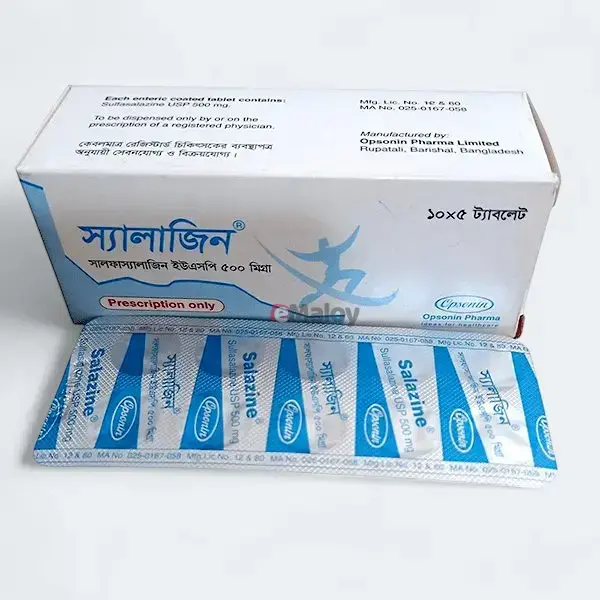
Salazine (Sulfasalazine): An Anti-inflammatory and Immunomodulatory Agent
Salazine contains Sulfasalazine, a drug indicated for the treatment of various inflammatory conditions. It is used in rheumatoid arthritis and juvenile arthritis when other NSAIDs are insufficient, and as an adjunct in the treatment of ulcerative colitis and active Crohn's disease, particularly with colonic involvement. Its therapeutic class includes Drugs for Irritable Bowel Syndrome, Drugs used for Rheumatoid Arthritis, and Ulcerative Colitis.
How Salazine Works (Pharmacology)
The exact mode of action of Sulfasalazine is still being investigated, but it is believed to involve:
- Anti-inflammatory and/or Immunomodulatory Properties: These properties have been observed in various animal and in vitro studies.
- Affinity for Connective Tissue: Sulfasalazine has a notable affinity for connective tissue, and it reaches relatively high concentrations in serous fluids, the liver, and intestinal walls.
- Active Metabolites: In ulcerative colitis, clinical studies suggest that the major therapeutic action may reside in its metabolite, 5-Aminosalicylic Acid (5-ASA). The relative contribution of the parent drug and its major metabolites in rheumatoid arthritis is currently unknown.
Key Indications & Benefits
Salazine is indicated for:
- Rheumatoid Arthritis & Juvenile Arthritis: For patients (adult and pediatric with polyarticular-course juvenile rheumatoid arthritis) who have not responded adequately to salicylates or other non-steroidal anti-inflammatory drugs (NSAIDs).
- Ulcerative Colitis and Crohn's Disease: As an adjunct in the treatment of ulcerative colitis, and for active Crohn's disease, especially when the colon is involved.
Dosage & Administration
The dosage of Sulfasalazine should be individually adjusted based on patient tolerance and response, and taken in evenly divided doses, preferably after meals. Always consult a registered physician for specific dosage instructions.
- Adult dose for Crohn's Disease: 500 mg orally 2 to 4 times a day with food.
- Pediatric use (6 years or older) for Ulcerative Colitis: Initial dose 40 to 60 mg/kg/day orally, divided into 3 to 6 doses.
- Adult dose for Rheumatoid Arthritis: 2 g daily in two evenly divided doses. It is advisable to start with a lower dosage (e.g., 0.5 to 1.0 g daily) to reduce gastrointestinal intolerance.
- Suggested dosing schedule for Rheumatoid Arthritis (adults):
- First week: One tablet in the evening.
- Second week: One tablet in the morning & one tablet in the evening.
- Third week: One tablet in the morning & two tablets in the evening.
- Fourth week: Two tablets in the morning & two tablets in the evening.
- Rheumatoid Arthritis (6 years or older): Initial dose 10 mg/kg/day orally in 2 equally divided doses.
- Juvenile Rheumatoid Arthritis (polyarticular course, children 6 years and older): 30 to 50 mg/kg/day in two evenly divided doses. Maximum dose is typically 2 g per day.
- For other indications (Initial Therapy):
- Adults: 3 to 4 g daily in divided doses with dosage intervals not exceeding eight hours. May start with 1 to 2 g daily to reduce GI intolerance.
- Children 6 years and older: 40 to 60 mg/kg/day in 3 to 6 divided doses.
- For other indications (Maintenance Therapy):
- Adults: 2 g daily.
- Children 6 years and older: 30 mg/kg/day in 4 divided doses.
Important Considerations & Warnings
It is crucial to discuss your full medical history with your doctor before taking Salazine.
Contraindications:
- Hypersensitivity to Sulfasalazine, its metabolites, sulfonamides, or salicylates.
- Patients with intestinal or urinary obstruction.
- Patients with porphyria.
Side Effects:
- Common adverse reactions: Anorexia (loss of appetite), headache, nausea, vomiting, gastric distress, dyspepsia (indigestion), abdominal pain, dizziness, and apparently reversible oligospermia (low sperm count).
Pregnancy & Lactation:
- Pregnancy: Classified as Pregnancy Category B. This drug should be used during pregnancy only if clearly needed.
- Lactation: Caution should be exercised when Sulfasalazine is administered to a nursing mother, as small amounts may be excreted in human milk.
Precautions & Warnings:
- Hepatic/Renal Impairment: Administer with caution in patients with impaired liver or kidney function.
- G6PD Deficiency: Use with caution in patients with Glucose-6-phosphate dehydrogenase (G6PD) deficiency.
- Allergic Bronchial Asthma: Use with caution in patients with a history of allergic bronchial asthma.
Storage Conditions
Store in a cool and dry place, protected from light. Keep out of the reach of children.



Comment