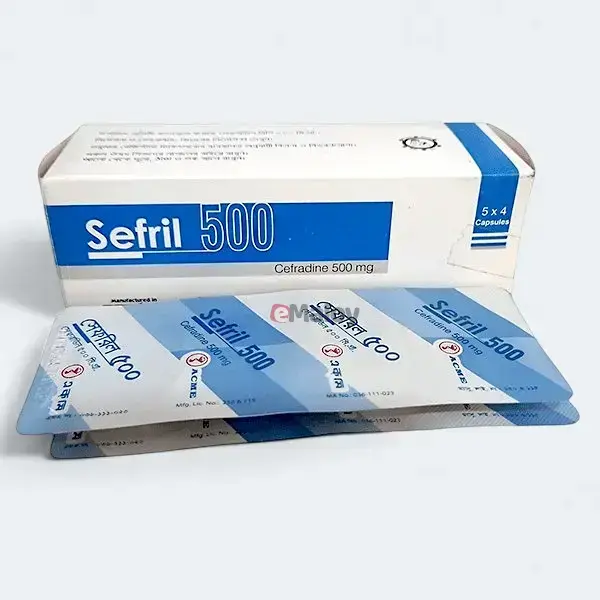
Sefril (Cephradine): A First-Generation Cephalosporin Antibiotic
Sefril contains Cephradine, a semisynthetic broad-spectrum bactericidal antibiotic. It is a first-generation cephalosporin effective against both Gram-positive and Gram-negative bacteria. Its primary mechanism of action is inhibiting bacterial cell wall synthesis, leading to bacterial lysis. It is used to treat a variety of infections and belongs to the therapeutic class of First-generation Cephalosporins.
How Sefril Works (Pharmacology)
Cephradine's bactericidal action is due to its interference with bacterial cell wall synthesis:
- Cell Wall Inhibition: Cephradine inhibits the cross-linking process of peptidoglycans, which are essential components of the bacterial cell wall.
- Cell Lysis: By preventing the formation of a rigid cell wall, it leads to the creation of a porous cell wall. This makes the bacteria susceptible to external osmotic pressure, causing the bacterial cell to lyse and die.
- Broad Spectrum: It is active against a wide range of bacteria, including many Gram-positive and Gram-negative organisms, as well as penicillinase-producing strains that are resistant to ampicillin.
Key Indications & Benefits
Sefril is indicated for the treatment of infections caused by sensitive bacteria, including:
- Upper respiratory tract infections (URTI): Sinusitis, pharyngitis, tonsillitis, laryngo-tracheo bronchitis, and otitis media.
- Lower respiratory tract infections (LRTI): Acute and chronic bronchitis, lobar pneumonia, and bronchopneumonia.
- Urinary tract infections (UTI): Cystitis, urethritis, and pyelonephritis.
- Skin and soft tissue infections: Abscess, cellulitis, furunculosis, and impetigo.
It is effective against common pathogens like Staphylococci (including penicillin-resistant strains), Streptococcus pyogenes, Streptococcus pneumoniae, Escherichia coli, Klebsiella spp., Proteus mirabilis, and Haemophilus influenzae, among others.
Dosage & Administration
Sefril is available for both oral and injectable administration. Dosage varies depending on the patient's age, infection type, and severity. Always consult a registered physician for specific dosage instructions.
Oral Administration:
- Adults:
- Urinary tract infections: 500 mg four times daily or 1 g twice daily.
- Respiratory/Skin/Soft tissue infections: 250 to 500 mg four times daily or 500 mg to 1 g twice daily.
- Children:
- General: 25 to 50 mg/kg total daily dose, in two or four equally divided doses.
- Otitis media: 75 to 100 mg/kg total daily dose, in divided doses every 6 to 12 hours.
- Maximum daily dosage: 4 gm.
- Elderly: Normal adult dose is appropriate, but patients with impaired renal or hepatic function should be monitored.
Injectable Administration (IV/IM):
- Adults: 2-4 gm daily in four equally divided doses, up to 8 gm daily in severe cases.
- Prophylaxis: A single preoperative dose of 1-2 gm intramuscularly or intravenously.
- Children: 50-100 mg/kg daily in four equally divided doses, up to 300 mg/kg daily in severe infection.
Important Considerations & Warnings
It is crucial to discuss your full medical history with your doctor before taking Sefril.
Contraindications:
- Patients with known or suspected hypersensitivity to cephalosporins.
Side Effects:
- Common: Gastrointestinal disturbances, hypersensitivity reactions (more likely in those with a history of allergy, asthma, or hay fever), skin reactions.
- Rare: Glossitis, heartburn, dizziness, tightness in the chest, nausea, vomiting, diarrhea, abdominal pain, vaginitis, candidal overgrowth.
- Serious: Blood disorders (thrombocytopenia, leucopenia), fever, serum sickness-like reactions, anaphylaxis, confusion, sleep disturbances, hyperactivity, transient hepatitis, cholestatic jaundice, reversible interstitial nephritis.
Pregnancy & Lactation:
- Pregnancy: Safety in pregnancy has not been established, although animal studies have not shown teratogenicity.
- Lactation: Cephradine is excreted in breast milk and should be used with caution in nursing mothers.
Precautions & Warnings:
- Hypersensitivity: Administer with care to patients with a hypersensitivity to penicillins due to the risk of cross-sensitivity between beta-lactam antibiotics.
- Superinfection: Prolonged use may lead to superinfection by resistant organisms.
- Coombs' Test: Cephalosporin antibiotics may cause a positive Coombs' test result.
- Urine Glucose Test: May cause a false-positive urine glucose result with Benedict's or Fehling's solutions or Clinitest tablets. This does not occur with enzyme-based tests.
- Renal Impairment: Dosage adjustment is necessary.
Drug Interactions:
- Nephrotoxic drugs (e.g., aminoglycosides) and Diuretics (e.g., furosemide): Concomitant use may increase the risk of kidney damage.
- Probenecid: Enhances the possibility of renal toxicity.
Overdose Effects
- Symptoms: Non-specific, including nausea, vomiting, diarrhea, and gastric upsets.
- Treatment: Primarily supportive. Gastric lavage may be necessary if a large amount has been ingested.
Storage Conditions
- Oral Suspension: Freshly prepared suspension should be used within 7 days at room temperature or 14 days if refrigerated.
- Injection Solution: Use within 2 hours at room temperature, or 12 hours if refrigerated at 5°C. Reconstituted solutions may vary in color, which does not affect potency.
- Keep all medicines out of the reach of children.
- Do not use after the expiry date.




Comment