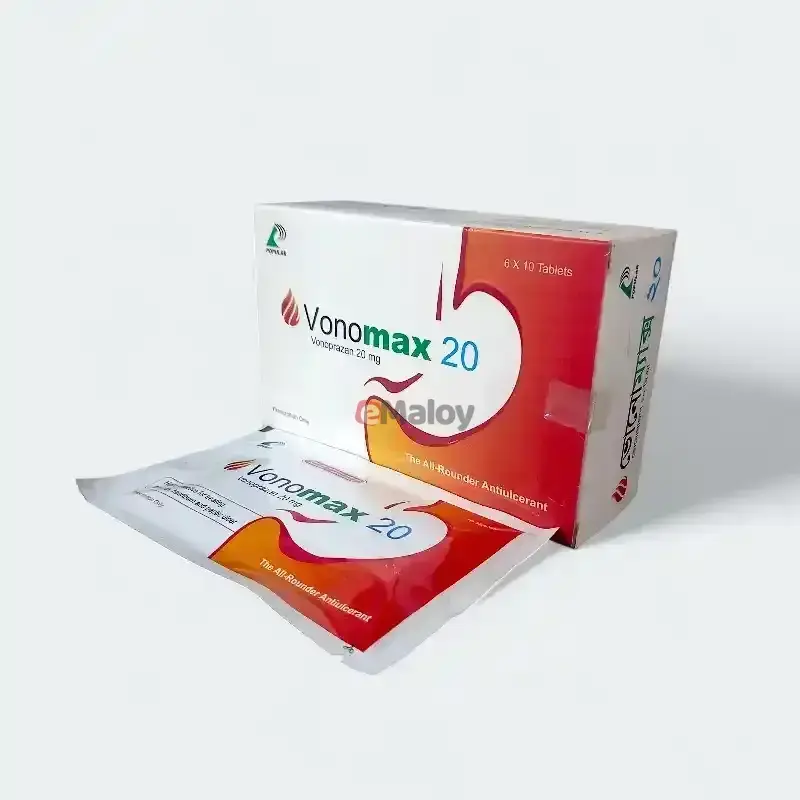
Vonomax (Vonoprazan): A Potassium-Competitive Acid Blocker (P-CAB)
Vonomax contains Vonoprazan, a potassium-competitive acid blocker (P-CAB). It is a highly effective medication that inhibits gastric acid production by reversibly blocking the H+, K+-ATPase pump in the stomach's parietal cells. This action makes it distinct from traditional proton pump inhibitors (PPIs) and allows it to provide strong, long-lasting acid suppression. Vonomax is indicated for various gastric and duodenal conditions and as an adjunct for Helicobacter pylori eradication.
How Vonomax Works (Pharmacology)
Vonoprazan's mechanism of action is based on its direct and reversible inhibition of the gastric acid pump:
- Potassium-Competitive Inhibition: It competitively binds to and inhibits the H+, K+-ATPase pump, also known as the proton pump, which is responsible for the final step of acid secretion in the stomach.
- Acid-Independent Action: Unlike PPIs, Vonoprazan does not require activation by acid. This allows it to work quickly and effectively, even in a non-acidic environment.
- Long-lasting Effect: Its strong basicity allows it to reside on the acid production site of parietal cells for an extended period, leading to potent and prolonged inhibition of gastric acid production.
Key Indications & Benefits
Vonomax is indicated for:
- Gastric and duodenal ulcers.
- Reflux esophagitis and its maintenance therapy.
- Prevention of recurrence of gastric or duodenal ulcers during the use of low-dose aspirin or NSAIDs.
- Adjunctive therapy for H. pylori eradication as part of a three-drug regimen.
Dosage & Administration
Vonomax can be taken without regard to food. The dosage and duration of treatment vary depending on the condition being treated. Always consult a registered physician for specific dosage instructions.
- Gastric Ulcer: 20 mg once daily for 8 weeks.
- Duodenal Ulcer: 20 mg once daily for 6 weeks.
- Reflux Esophagitis: 20 mg once daily for 4 to 8 weeks. For maintenance, 10 mg once daily, which may be increased to 20 mg if needed.
- H. pylori Eradication: 20 mg of Vonoprazan, 750 mg of amoxicillin, and 200 mg of clarithromycin (or 250 mg of metronidazole) twice daily for 7 days.
Important Considerations & Warnings
It is crucial to discuss your full medical history with your doctor before taking Vonomax.
Contraindications:
- Hypersensitivity to Vonoprazan or any of the excipients.
- Concomitant use with atazanavir sulphate, nelfinavir, or rilpivirine hydrochloride.
Side Effects:
- Common: Diarrhea, constipation, nausea, and abdominal distension.
- Hypersensitivity: Drug hypersensitivity reactions, rash, and urticaria.
- Liver-related: Increased liver enzymes (AST, ALT, ALP), abnormal liver function tests, and jaundice.
- Other: Edema and eosinophilia.
Pregnancy & Lactation:
- Pregnancy: It should be used in pregnant women only if the expected therapeutic benefit outweighs any potential risk.
- Lactation: It is advisable to avoid administration to nursing mothers. If use is essential, breastfeeding should be discontinued.
Precautions & Warnings:
- Long-term use: For long-term treatment, close observation (e.g., via endoscopy) should be performed.
- Recurrence: In maintenance therapy for reflux esophagitis, it should only be administered to patients who have repeated recurrence.
- Special Populations: Use with caution in the elderly due to decreased physiological functions. It is not recommended for children and adolescents under 18 or for patients with moderate to severe hepatic or renal impairment.
Drug Interactions:
- Atazanavir, Nelfinavir, Rilpivirine: Use is contraindicated.
Overdose Effects
- There is no experience of overdose with Vonomax.
- It is not removed from the circulation by hemodialysis.
- Treatment for overdose should be symptomatic and supportive.
Storage Conditions
Store below 30°C in a cool and dry place, away from light. Keep out of the reach of children.




Comment